
Step into any Rajasthani bazaar and you’ll hear a dozen melodies in one language. A shopkeeper in Jodhpur might greet you with a hearty “के हाल है सा?” while a trader in Udaipur would say it in a gentler “के हाल जो?” — both meaning “How are you?” Both mean “What are you doing?” — yet they carry different textures, tones, and temperaments. That’s the beauty of Rajasthan — one land, many tongues, each with its own story.
Rajasthan speaks in many voices
Rajasthan, the “Land of Kings,” is not defined by a single language but by a amalgamation of dialects woven across its deserts, hills, and lakes. Linguists call this family the Rajasthani languages, a branch of the Indo-Aryan group that includes Hindi and Gujarati. But for locals, it’s simpler: every region speaks its own version of home.
As described in the Sociolinguistic Survey of Selected Rajasthani Speech Varieties by SIL International (2012), there are more than a dozen speech varieties across the state, each rooted in geography and heritage.
The largest and most widely recognized dialect is Marwari, spoken across western Rajasthan — Jodhpur, Barmer, Nagaur, Pali, and Jaisalmer. Yet Marwari is just one thread. Travel east and the sounds begin to change, shifting with geography, trade routes, and royal histories. From the melodic tones of Mewari to the nasal notes of Bagri, Rajasthan’s dialects mirror its landscape — diverse, layered, and full of character.
The roots of Rajasthani dialects
Long before Hindi gained prominence, Old Western Rajasthani — also known as Maru-Gurjar or Dingal — was the classical literary tongue of the region. Ancient poets of the 15th and 16th centuries used it to compose devotional and heroic ballads.
As detailed in G.A. Grierson’s Linguistic Survey of India (Vol. IX, Part II) (1920), this ancient language evolved over centuries into modern dialects, branching into Marwari, Mewari, Dhundhari, Harauti, and others. Though distinct, they remain mutually intelligible, sharing a strong cultural and grammatical core.
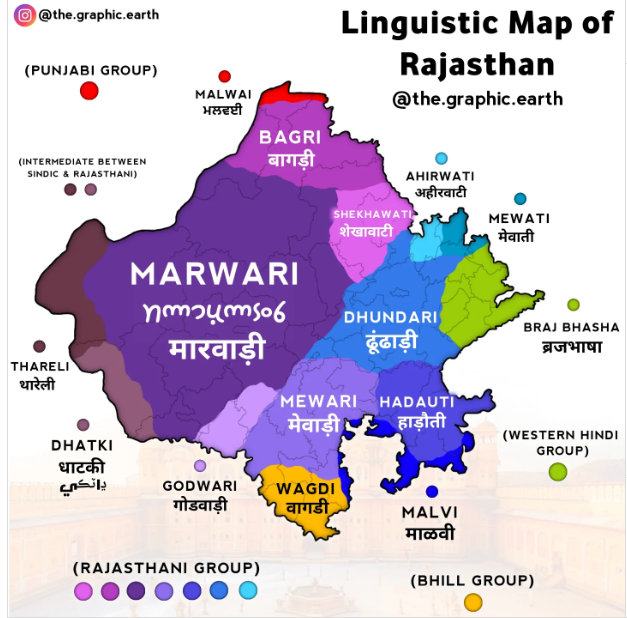
Picture Credits: IG/@the.graphic.earth
The major dialects of Rajasthan
1. Marwari — the heart of the desert
Spoken across Jodhpur, Pali, Barmer, Nagaur, and Jaisalmer, Marwari is often considered the backbone of Rajasthani speech. Its sharp edges and lively tone reflect the desert people’s humor and resilience. A single word like “थारी” (your) can carry affection or sarcasm, depending on how it’s said. Marwari is rich in proverbs and quick wit — locals often joke that “Marwari boli mein bhi vyapar hai,” meaning “Even the Marwari language sounds like business.”
According to the Rajasthan Administrative Services portal (RajRAS), Marwari is spoken by over 6 million people and has many sub-varieties, including Thali and Jaisalmeri. The dialect’s reach even extends into Sindh (Pakistan) and Gujarat, carried by traders and migrant families. Many Rajasthani communities abroad still use Marwari at home, keeping it alive across generations.
2. Mewari — the language of lakes and hills
If Marwari is the language of the desert, Mewari is the music of the hills. Spoken mainly in Udaipur, Rajsamand, Chittorgarh, and Bhilwara, it has a softer, almost song-like rhythm. The region’s royal heritage — the seat of the Mewar dynasty — shaped Mewari’s refined vocabulary and respectful tone. Words like “हुजूर” (sir) and “साहब” often find place in everyday talk, showing the blend of courtly etiquette and rural warmth.
Mewari has inspired many folk songs and ballads — “Kesariya Balam”, Rajasthan’s iconic welcome song, is originally from the Mewari region.
- Shekhawati — the dialect of storytellers
In Sikar, Jhunjhunu, and parts of Churu, the Shekhawati dialect reigns. It’s a fascinating mix of Marwari and Hindi influences, shaped by its trading history. Shekhawati merchants were famous for their travels across India, and their dialect absorbed words from places as far as Bengal and Bombay.
Shekhawati has a lively twang — a playful rhythm that mirrors the region’s famous painted havelis and oral storytelling tradition. Locals are known for their quick humor and sharp repartee. A simple exchange like “थारे घर कदे आवैसा?” (When will you visit home?) captures the warmth and teasing tone of Shekhawati speech.
4. Bagri — the border blend
Up north, in Ganganagar and Hanumangarh, Bagri echoes across the plains bordering Punjab. Its vocabulary and pronunciation carry clear Punjabi influence — you’ll hear nasal tones and softer consonants. Linguists call Bagri a “transitional dialect” because it bridges western Rajasthani and north Indian speech patterns.
Despite being less known to outsiders, Bagri is vibrant in local songs and folk theatre. It’s also common among farmers and traders who connect Rajasthan with Haryana and Punjab.
5. Dhundhari — Jaipur’s royal tongue
Around Jaipur, Tonk, and Dausa, people speak Dhundhari, named after the ancient Dhundhar region. It’s perhaps the most urbanized of the Rajasthani dialects, thanks to Jaipur’s modern development and tourism. Dhundhari blends smoothly with Hindi, making it easy to understand even for visitors. It’s known for its clear pronunciation and polite phrasing, often heard in the old markets of Johari Bazaar or Amer town.
6. Harauti — the voice of the east
In Kota, Bundi, and Baran, you’ll hear Harauti, a dialect that borrows from both Rajasthani and Malvi (from Madhya Pradesh). The region’s history as a princely state under the Hadas Rajputs gives Harauti a distinct rhythm. Its words are rounded and soft, often ending in “ण” or “ई”. Phrases like “रांधण” (cooking) and “जीणो” (to live) sound unique even within Rajasthan.
7. Godwari — the southern bridge
In Sirohi, Pindwara, and parts of Pali, Godwari acts as a bridge between Marwari and Gujarati. This dialect reflects the trade ties that once connected southern Rajasthan with Gujarat’s merchant towns. Locals switch between the two languages fluidly, and the mix adds a musical charm to daily speech.
8. Mewati — the tongue of the Mewat plains
In the eastern belt — Alwar, Bharatpur, and Dholpur — the Mewati dialect flourishes. It’s closely related to Haryanvi, spoken by the Meo community. Mewati carries the rhythm of folk songs and Sufi traditions, connecting language with spirituality. Words are stretched, tones are softer, and sentences often carry a poetic touch.
Shared roots, shared soul
The diversity of Rajasthani dialects isn’t random — it’s born from geography. The Thar Desert shaped Marwari’s directness and brevity — short words conserve both time and breath. The Aravalli hills gave rise to Mewari’s musical tone. The plains and trade routes of Shekhawati and Bagri added external influences from Hindi, Punjabi, and Gujarati. Each landscape left an imprint on how its people speak and express themselves.
Even climate plays a part — in desert areas, words are clipped and fast; in greener regions, the flow slows down, mirroring the land’s calm.
Despite their differences, all Rajasthani dialects share something deep — a sense of pride, hospitality, and poetic emotion. Words like “Baisa” (a term of respect for a woman) or “Thakursa” (for a man) resonate across regions, carrying the same reverence. Proverbs too travel freely: “Jisko Ram rakhe, usko kaun chakhe” — “The one protected by God, who can harm him?”
This shared linguistic DNA keeps Rajasthan united — a state where diversity doesn’t divide but decorates the identity.
The modern shift — from dialects to Hindi
Urbanization, education, and media have gradually made Hindi the dominant language in Rajasthan’s cities. Younger generations, especially in Jaipur, Jodhpur, and Udaipur, now speak a Hindi mixed with traces of their local dialects — a kind of “Rajasthani Hinglish.” While it brings connection to the outside world, it also risks fading the purity of these native tongues.
Thankfully, revival efforts are growing — YouTube creators making dialect content, folk singers bringing traditional lyrics back, and schools slowly introducing regional studies. The pride in speaking one’s mother tongue is finding its voice again.
Language in Rajasthan is more than communication — it’s emotion, identity, and memory. Each dialect tells a story of where it was born: the dunes, the palaces, the markets, the songs. Whether it’s Marwari’s punchy humor or Mewari’s gentle lilt, each carries the heartbeat of its people.
Rajasthan doesn’t speak in one voice — it sings in many. And together, those voices form the soul of Maru Bhoomi, the desert land that still whispers its stories through words, old and new.
📚 Sources & References
- SIL International (2012) — Sociolinguistic Survey of Selected Rajasthani Speech Varieties of Rajasthan
- G.A. Grierson (1920) — Linguistic Survey of India, Vol. IX, Part II
- Rajasthan Administrative Services (RajRAS) — Rajasthani Literature and Dialects (rajras.in)
- Wikipedia — Entries on Marwari language, Mewari dialect, and Mewati language

